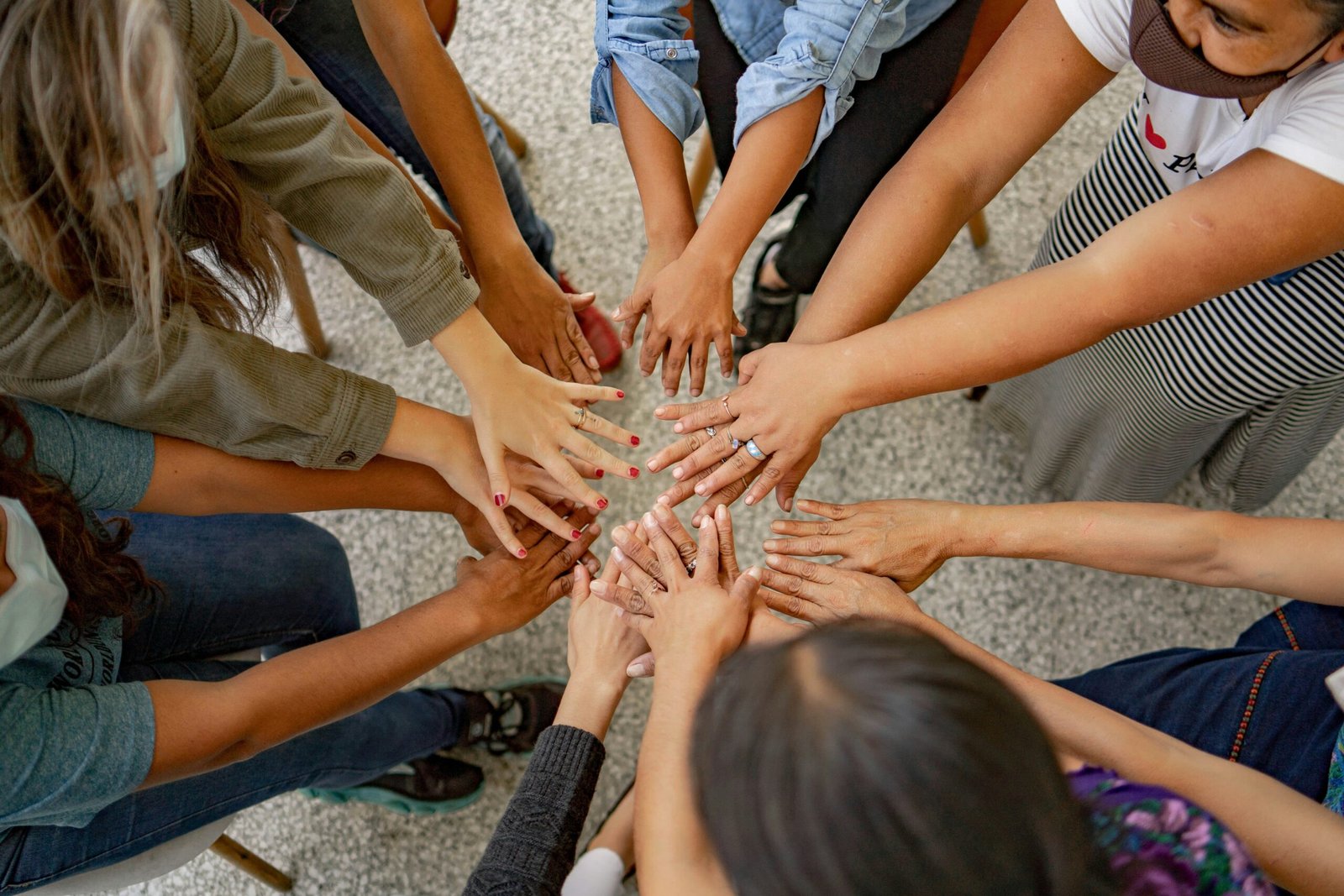
Image Credit: Shelby Murphy Figueroa on Unsplash.com.
July 2025 – Written for Ability Beyond Borders (www.abilitybeyondborders.org)
In fighting for our rights, it is very important that members of the disabled community understand the concept of intersectionality and always consider how it applies to our advocacy.
What does intersectionality mean and why is it important?
Intersectionality is:
“The way in which different types of discrimination (e.g. unfair treatment because of a person’s sex or race) are connected to and affect each other.” (Merriam-Webster)
When they are combined, two or more protected characteristics (e.g. someone’s race and sexual orientation) can put them at an even greater disadvantage in society. When someone discriminates against someone for more than one reason, it is called “multiple discrimination” (FRA, no date).
Disability and Gender Rights
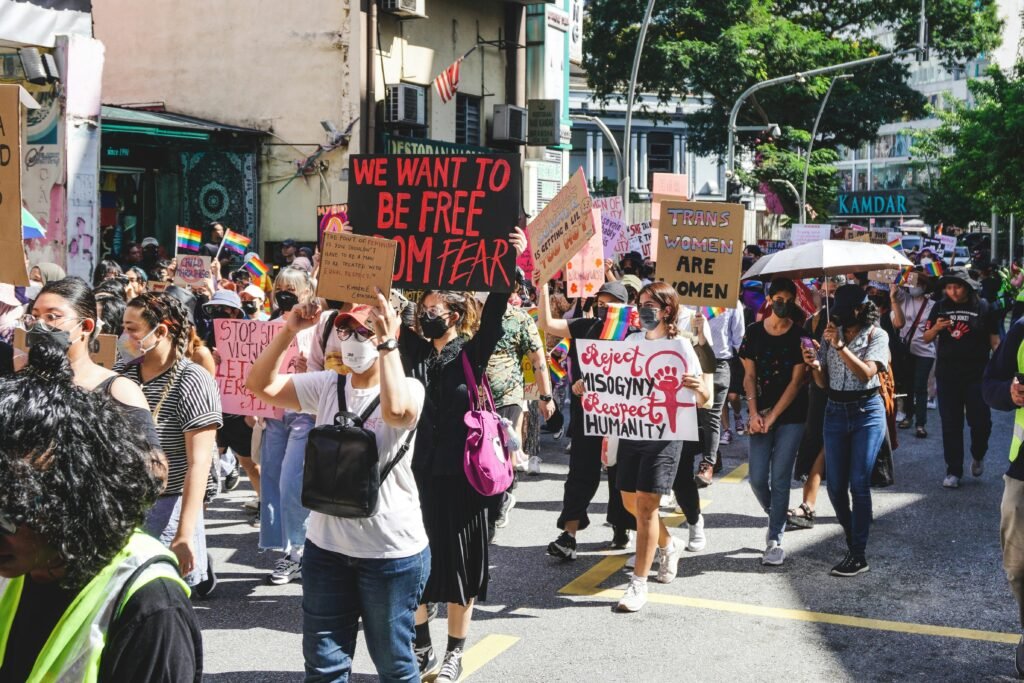
Image Description: People shown walking down a street at a women’s rights march in Kuala Lumpur, Malaysia in 2023. They are holding placards, with one reading “reject misogyny, respect humanity”.
Image Credit: Michelle Ding on Unsplash.com.
One example of how multiple discrimination can happen is when a woman’s disability is used to discriminate against them, as well as their gender. Women are often assigned a lower social, economic and political status, which can be made even worse when somebody is also disabled. Disabled girls and women are often sidelined, neglected and considered a burden (SPARK, 2022).
Patriarchal and ableist systems in our society intersect to give way to violence, erosion of agency and contribute to poor material conditions. For example:
- Girls and boys with disabilities are significantly more likely to be (3x more, according to BOND) subjected to sexual violence than those without disabilities, with girls being the most at risk (BOND, n.d.).
- In Uganda, in 2016, women with disabilities were almost twice as likely to experience sexual violence as non-disabled women were, almost four times as likely as disabled men, and around six times as likely as non-disabled men (UN, 2018).
- Someone’s disability can also be used as a vulnerability or a way to attempt to evade responsibility for their abuse. A study of child sexual abuse victims in Thailand found that there were certain brothels that deliberately trafficked girls with hearing impairments due to the assumption that they couldn’t communicate and ask for help.
- Disabled women are often paid lower than disabled men. For example, across Bolivia, Costa Rica, Peru, Mexico, Chile and Panama, wages for disabled men were on average 17% higher than for disabled women (UN, 2024). As well as this, in people with disabilities in 30 out of 35 European countries surveyed in 2016, more women were unable to adequately heat their homes than men (UN, 2018).
In equality policy, states around the world pay insufficient attention to intersectionality between gender, sexual rights and disability
Many countries wrongly address gender and disability rights issues separately without paying sufficient attention to the intersection between the two, and a UN report in 2018 stated that “women and girls with disabilities are often invisible in national policies and programmes”. Awareness has, however, been growing. A study in Latin America has shown that 17 out of 20 countries in the region included disability in their gender plans, with 12 of these countries having gender plans that include specific actions aimed at supporting women with disabilities. Despite this, just 6 of the 19 countries addressed gender in their laws on disability (UN, 2018).
In the UK, the Equality Act 2010 is one of the main legal frameworks that address discrimination, recognising nine protected protected characteristics. These include race, disability, age, sex, religion or belief, gender re-assignment, sexual orientation, marriage or civil partnership, pregnancy and maternity. Although Section 14 of the Act specifically addresses combined discrimination and prohibits direct discrimination because of a combination of two characteristics, the act still largely addresses characteristics separately, and more could be done to address the intersection between them (Christoffersen, 2021) (Edwin Coe, no date).
Case Study – China
In China, some laws still are not in line with the principles set forth in the UN Convention of the Rights of Persons With Disability (CRPD), and there is a need for significant improvement in the ways they address intersectionality. The UN CRPD includes several areas that closely relate to sexuality, such as providing disabled people with the same range (and quality) of free or affordable sexual and reproductive health services.
China’s legal framework around disability does not pay any real attention to the sexual and reproductive needs of disabled adults and young people. An example of where intersectionality has not been properly recognised is in the first Chinese Anti-Domestic Violence Law where, although physical and psychological violence against disabled people is targeted, sexual violence is not discussed. The lack of attention towards sexual and reproductive health needs in China can partly be attributed to the idea that “people with disabilities are erroneously considered asexual, with no sexual desires or needs” (Aresu & Mac-Seing, 2019).
Another attitude prevalent in Chinese society that may have a profound impact on the wellbeing of disabled people is that there is an incredibly widespread expectation for young people to seek marriage and have children, which is an attitude reinforced by heteronormative discourse that is deep-seated in conversations on policy, sex education and family. The search for a partner is often “deeply influenced by traditional standards of health, beauty and strength”, qualities that disabled people are often not considered to possess. Women with disabilities are also often not given any space to express their sexual identity (Aresu & Mac-Seing, 2019).
Barriers facing disabled people in accessing sexual and reproductive health services (SRH)
One important aspect of intersectionality between gender and disability is that disability can present unique barriers to accessing SRH services. For example, potential practical barriers include:
- Lack of appropriate workforce training, poor attitude towards disability and a lack of access to information create an exclusive environment – a study of the barriers facing disabled people in accessing SRH services in Africa uncovered issues such as healthcare workers lacking appropriate skills in dealing with disabled people, as well as a lack of adaptation of information to suit disabled people and poor attitudes about sexuality issues in disabled people (Ganle et al., 2020).
- Arbitrary exclusion – Disabled children and adolescents have often been excluded from sexuality education programs due to the assumption that there is no need to give them this information (Women Enabled, n.d.).
- Barriers introduced by bias – Heterosexual and gender bias may create further barriers for young women and nonbinary disabled young people (Ride & Newton, 2018).
- Reproductive ableism – The idea that disabled women shouldn’t become parents may also introduce bias
- Psychological and social barriers arising from wider society -Even when the necessary services are accessible, disabled women and girls may still have difficulty in accessing them due to psychological and social barriers (Women Enabled, n.d.).
The disabled and non-binary experience
The intersection of non-binary and disabled experiences is a complex area. Non-binary people are at a significantly higher risk of experiencing discrimination, harassment and even violence. Non-binary people are already highly stigmatised, with 76% of UK-based non-binary respondents in a 2017 survey saying that they had avoided expressing their identity out of fear of negative reaction from others (Government Equalities Office, 2018). A non-binary person also being disabled adds another dimension to this, and someone may face difficulties in accessing employment, healthcare and education. In socially conservative Asian settings where non-binary identities don’t receive as much attention in the media, this oppression may take a different form or be more pronounced than in western countries. In a 2017 study of transgender and non-binary people in China, 73.2% of all respondents reported experiencing varying levels of anxiety (29.4% of respondents had mild anxiety, 11.8% of respondents had moderate anxiety levels and 21.1% of the respondents had severe anxiety), and 61.5% reported experiencing depression (with 32.1% being at high risk and 29.4% having depressive tendencies) (China Development Brief, 2017).
Case Study – Taiwan
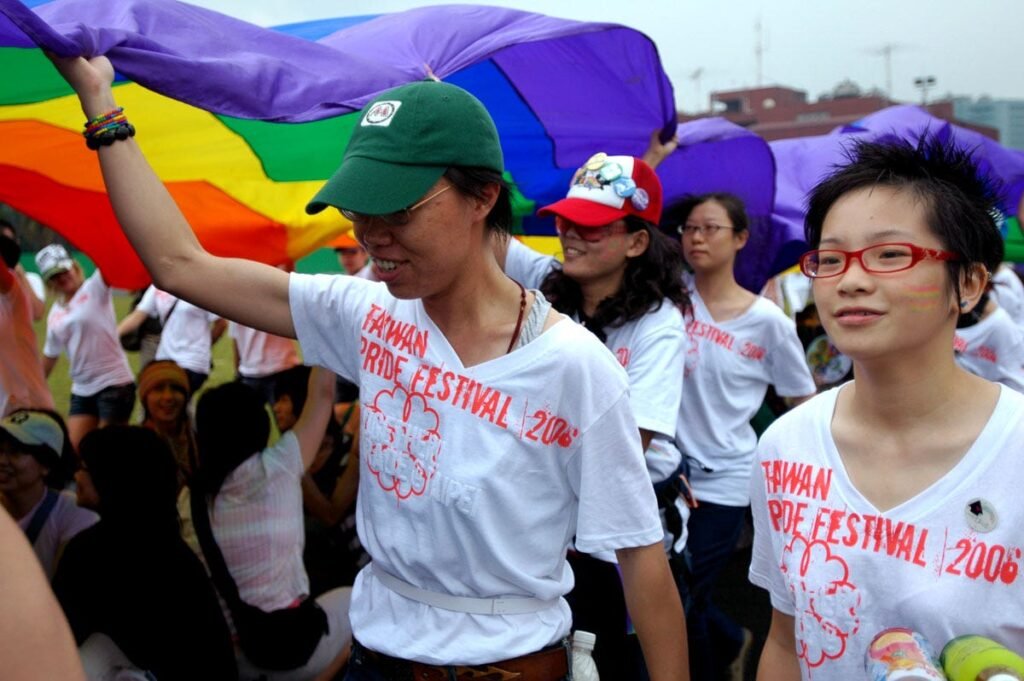
Image description: women walking at a pride march in Taipei, Taiwan, flying an LGBTQ+ pride flag, wearing white t-shirts reading “Taiwan Pride Festival 2006).
Image Credit: (“Taiwan Pride” by Chun Li, CC BY 2.0)
.jpg)
In 2014, Taiwan passed a law to implement the UN Convention on the Rights of Persons with Disabilities (Chang, 2019). Taiwan is recognised as among Asia’s most progressive countries with regards to gender and sexuality, becoming the first Asian country to legalise same-sex marriage in 2019 and ranking 7th out of 171 countries in the 2021 Gender Inequality Index (Amnesty International, 2019), (Taiwan MOFA, 2024). Despite this ranking, there are issues such as a significant gap in women and men’s labour participation, which was at 51.4%, 16 percent lower than men’s (ROC, 2021).
Although the country has a comparatively liberal attitude towards sexuality compared to its other east Asian peers, people with intellectual disabilities in Taiwan do not have equal rights in the sphere of intimate relationships and parenting. Despite the fact that the People with Disabilities Rights Protection Act (2007) mandates the government to provide reproductive and marital health counselling to disabled people, the related policies and support actually rendered to people with intellectual disabilities in Taiwan has not been properly realised. Opportunities for education about sex and reproductive health for people with intellectual disabilities and hearing impairments are also more limited (Lu & Beddoe, 2022).
Intersectionality between gender, sexual orientation and disability in South Korea
South Korea ratified the CRPD in 2008 but struggles greatly with systemic discrimination. The main law that exists to protect disabled people in South Korea Is the Act on Welfare of Persons with Disabilities, as well as the “Act on the Prohibition of Discrimination of Disabled Persons and Remedy Against Infringement of their Rights”. By themselves, however, these laws aren’t enough and only sparing reference intersectional issues, going into a small amount of detail on women’s rights issues and completely ignoring issues of sexual orientation (KLRI, 2020) (UN, 2014). South Korea falls significantly below global standards in its legal framework around minority rights. In countries that are part of the OECD, it is one of two countries (alongside Japan) that does not have a comprehensive anti-discrimination law. Attempts have been made, but an Anti-Discrimination Act still remains unpassed (The Korea Times, 2024), (Amnesty International, 2021).
South Korean society is built upon strong Confucian values, emphasising conformity, gender roles and family reputation, contributing to stigma against disabled and LGBTQ+ people (Hindustan Times, 2024). In sharp contrast to Taiwan, sexual minorities face significant challenges. A survey by the Korea Institute of Public Administration in 2024 showed that more 52% of Koreans were opposed to living close by to a member of the LGBTQ+ community, with the only people less welcome than them being former convicts, who 72% of Koreans didn’t want to live around. 97%, however, said they would feel comfortable living among mentally or physically disabled people (Ryall, 2024).
South Korea can be an incredibly challenging environment for LGBTQ+ people to grow up in, with LGBTQ+ identities largely remaining repressed in the education system, with the national sexuality curriculum failing to incorporate any content exploring LGBT issues. As well as this, even though South Korea has counselling centres and youth hotlines for assistance around mental health, people who have used such services have reported them not affirming different gender identities and sexual orientations, at times even going as far as to being openly critical of them (Human Rights Watch, 2021). South Korea also has the unfortunate status as the country with the highest gender pay gap in the OECD (Organization for Economic Cooperation and Development), with women in Korea earning 31.2% less than men. There has also been evidence of a worrying regression in attitudes towards women’s rights among the public (The Diplomat, 2025). A 2023 report by South Korea’s Ministry of Gender Equality and Family found that the number of respondents who supported the statement that men should take primary responsibility for financially supporting their family rose from 22.4% to 33.6% in three years. The idea that housework is primarily a woman’s job rose from 12.7% to 26.4%. The statement that women should mostly be responsible for the care of children and elderly family members also rose from 12.3% to 21.5% (The Hankyoreh, 2024).
A positive development in South Korea’s new presidency is that the Ministry of Gender Equality and Family, which was once targeted by the previous presidency for restructuring and potential abolition, appears set to be expanded. New president Lee Jae-Myung’s blueprint for the ministry is being interpreted as involving it taking a greater role in the state’s policies around gender equality, while his conservative counterparts have made a significant effort to reduce its role. Previous president Yoon made the ridiculous claim that “there is no more gender discrimination on a structural level”. Although it is promising that the new presidency appears to be planning to increase the role of the ministry, it remains a significant issue that the position of minister has been vacant since 2024, with the organisation instead being led by its vice minister. It could be argued that the current state of the ministry, and the lack of an appointed minister, is a powerful indicator of South Korea’s deep political divisions over gender policy. It has drawn significant criticism from abroad, including from the UN (The Korea Herald, 2025). In advancing disability rights, it is vital that the South Korean government pays attention to women’s intersectional issues and adequately supports organisations such as this.
Conclusion
It is important to remember that intersectionality is not only a theoretical framework. It is an essential lens for understanding and addressing the complicated realities faced by disabled people, particularly those who also belong to other marginalised groups. It is clear that, when disability intersects with gender and sexual orientation (or other protected characteristics), individuals often face compounded discrimination and unique barriers that a single-issue approach will fail to address. All over the world, including in East Asia as this research has explored, governments and their policies frequently overlook these intersections, which results in inadequate legal protections, insufficient access to services and persistent social stigma. Disabled women, non-binary people and LGBTQ+ people are particularly vulnerable to violence, denial of agency and economic exclusion. Even in countries with otherwise progressive approaches (such as Taiwan in its treatment of sexual rights), gaps remain in policy and practice. In places such as China and South Korea, a lack of awareness of intersectionality in law and society leaves many people without the support and recognition they need.
Real progress in disability rights requires a deep commitment to intersectionality. This should take place at every level – in law, policy, advocacy and direct action. Only by acknowledging and paying attention to the full complexity of people’s identities are we able to move closer to true equality and justice for disabled people.
References
https://amp.dw.com/en/why-are-south-koreans-less-welcoming-of-lgbtq-neighbors/a-68698268?
https://anzswjournal.nz/anzsw/article/view/1040/912
https://assets.publishing.service.gov.uk/media/5b3cb6b6ed915d39fd 5f14df/GEO-LGBT-Survey-Report.pdf
https://chinadevelopmentbrief.org/wp-content/uploads/2020/04/2017-Chinese-Transgender-Population-General-Survey-Report.pdf
https://elaw.klri.re.kr/eng_mobile/viewer.do?hseq=55535&type=part &key=38
https://fra.europa.eu/en/content/multiple-discrimination-healthcare-qa#:~:text=Multiple%20discrimination%20takes%20place%20when,foc us%20of%20this%20FRA%20report.
https://pmc.ncbi.nlm.nih.gov/articles/PMC7549766/#abstract1
https://pubmed.ncbi.nlm.nih.gov/29852925/
https://social.un.org/publications/UN-Flagship-Report-Disability-Final.pdf
Intersectionality and Disability
https://thediplomat.com/2025/05/south-koreas-2025-election-a-test-for-gender-equality/
https://womenenabled.org/wp-content/uploads/Women%20Enabled%20International%20Facts%20-%20Sexual%20and%20Reproductive%20Health%20and%20Rights%20 of%20Women%20and%20Girls%20with%20Disabilities%20-%20ENGLISH%20-%20FINAL.pdf
South Korea: Lawmakers must seize chance to pass landmark anti-discrimination act
Taiwan becomes first in Asia to legalize same-sex marriage after historic bill passes
https://www.edwincoe.com/blogs/main/dual-discrimination-the-claim-that-time-forgot-and-a-possible-labour-government/#:~:text=Section%2014%20of%20the%20EqA%202010%2 0(yet,been%20direct%20discrimination%20in%20respect%20of%20ea ch
https://www.hani.co.kr/arti/opinion/column/1138644.html
https://www.intersectionalityinpractice.ed.ac.uk/wp-content/uploads/2021/09/Intersectionality-in-practice.pdf
https://www.koreatimes.co.kr/southkorea/law-crime/20241031/anniversary-korea-urged-to-enact-anti-discrimination-law-to-align-with-global-standards
https://www.oed.com/dictionary/intersectionality_n?tab=meaning_an d_use#335059764
https://www.roc-taiwan.org/lv_en/post/5141.html
https://www.un.org/development/desa/disabilities/wp-content/uploads/sites/15/2019/11/Korea-Republic-of_Act-on-the-Prohibition-of-Discrimination-of-Disabled-Persons-Remedy-Against-Infringement-of-their-Rights-etc.pdf
Leave a Reply